Part of my time volunteering with the Edith Wilkins Street Children Foundation is spent helping out in the office. While some elements of working in an office are universal, most of what I am doing in Darjeeling is far removed from what I did in Dublin.
My "commute" is a pleasant walk from my house (a two-bedroom flat provided by EWSCF for volunteers; for most of my time here so far it has been just me staying there, but another Irish volunteer is arriving in early December). This takes around 25 minutes; faster in the morning (downhill) and slower in the evening (uphill) - in Darjeeling you are always walking either up or down hills.
The work day starts at 9am with the children in the playground doing warm-up exercises and singing songs; starting with "All Things Bright and Beautiful" and ending with the national anthem.
On going up the stairs to the office, the first thing to be done is to check if there is electricity - power cuts are frequent, unpredictable and often last a couple of hours. Almost instantly, and continuously throughout the day, one of the "kitchen mothers" appears offering a cup of tea. I usually don't drink much tea or coffee, but I drink several cups a day here because its cold when you are out of direct sunlight (steam rises from the printer when pages come out) and, well, its Darjeeling, world famous for its tea.
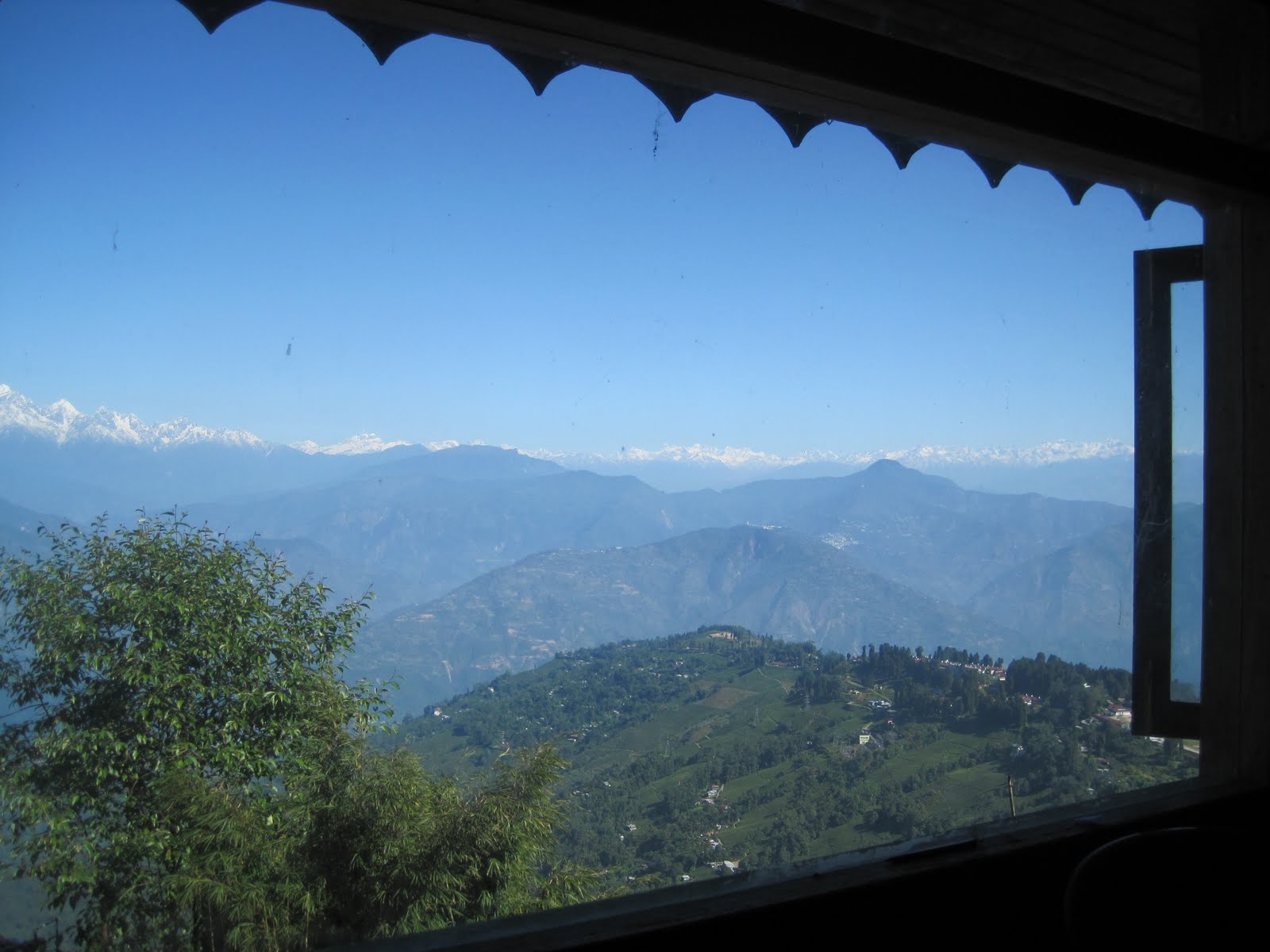
The EWSCF office has two unique features. Firstly, the view out the window is, without a doubt, the best view from an office I've ever seen. Looking down you see green hills covered in tea. And in the distance is Kanchenjunga - the world's third highest mountain. Its hard to stop looking out and start working.
 Secondly, on a less positive note, there is the office calendar.
 The black circles (see most of January and February) mark days when general strikes were called in Darjeeling by the local movement which include many whose ultimate aim is for this area to leave the state of West Bengal and to become an autonomous Gorkhaland. During strikes, no one is meant to go to work and there is an evening curfew. There were less strikes in 2011 compared with 2010, a year where an opposition politician was hacked to death in the street. I've been told that foreigners are never at risk here, and I have felt perfectly safe since arriving.
 Clearly I know very little about the political situation here. I have pieced a few things together through conversations and from reading Kiran Desai's Booker Prize-winning "The Inheritance of Loss" which is set in this area (although people I know here are not fans of that book). The only observations that I'll make relate to the map below, where West Bengal is shaded red.
 Firstly, a glance at the map gives an indication of why things are politically complicated, with Nepal, Bhutan, Tibet, China and the tiny autonomous Indian state of Sikkim all converging in this part of the world (this mix means that people in Darjeeling tend to have an interesting and not "typically Indian" physical appearance).
Secondly, the oddly-shaped state of West Bengal is mostly hot and flat, with cold and hilly Darjeeling attached in the north. Policies that are designed for Calcutta are often not suitable for Darjeeling. To give just one small example, the school uniform allowance is enough to buy the short-sleeved shirt and shorts that are suitable in the plains, but not enough for the layers that children need here. It is not difficult to see how people here, who speak Nepali rather than Hindi or Bengali, could feel aggrieved with how those in Calcutta or Delhi treat this area.
To get back to my work in the office, so far I've mainly been doing two things:
(1) Helping with the accounts - at times I've felt that I've stepped back to colonial times, like when using carbon paper to create, in triplicate, receipt vouchers for money spent on things like tiffin (a British Indian word for a light meal) and coolies (manual labourers who carry heavy goods). Details of all expenditure and copies of all receipts must be sent to Ireland. While the amount of paperwork sometimes seems excessive given the small amounts of money that many of the receipts are for, I understand that when it comes to money given to charities full and transparent accountability is vital.
(2) Writing up the case history for each child - its often difficult for me to reconcile the harrowing tales of neglect, abuse, violence and trafficking with the children happily playing outside in the playground.
Speaking of which, apart from the view, the best thing about working in this office is that when I need a break I can pop outside and play with the kids.


 Unfortunately Wales brought the dream of an Ireland - All Blacks final to an end. It was very disappointing, but I've had a great five weeks following the Irish team. It was a new experience for me and, while it was bizarre at times to constantly being surrounded by other Irish people, it was fun and something I would definitely recommend.
 to the touristy (I walked up "the world's steepest street") and fun (on my tour of Cadbury's chocolate factory I had to wear two hairnets - one for my head, the other for my beard);
 and Elaine and her posse flew in from Melbourne for the weekend);
 and
and I headed further south to Invercargill, which when I arrived at 6:30pm on the Monday seemed like a ghost town, especially when compared to the bustling Octagon city centre of Dunedin over the weekend. I drove around the Caitlins area, with its green fields full of lambs and its rugged coast full with a history of shipwrecks, and onto Bluff, the southern end of the Highway 1 that runs the length of New Zealand from Cape Reinga in the north (where I was back in February), to complete a memorable week in the South Island. From Invercargill, whose airport is the closest to a town centre that I've ever seen, I flew back up to Wellington where Ireland will play Wales for a place in the semi-final.
