Tuesday, March 20, 2012

Trekking in Nepal: Everest Base Camp

Dates: 8 - 19 March 2012
Start/end: Lukla (2860m)
High points: Everest Base Camp (5340m), Kala Patar (5550m)


While the primary goal of the walk to Everest Base Camp is to have great views and to see the world's highest mountain up close, this trek had something not just for the eyes but for all the senses.

Touch
As I was running out of time in Nepal, I did what the majority of trekkers now do by flying to Lukla to start the trek from there. Although I'm not a nervous flyer, that flight from Kathmandu in a 14-seater plane, where the cabin crew handed out cotton wool to use as earplugs, is not one I'd like to do too often. The amazing mountain views out my window failed to distract me from what I could see by looking straight ahead through the cockpit's window. Lukla's short runway, which slopes at a 12 degree angle upwards, starts at the top of a cliff, and it looked from my angle that we were flying straight for that cliff-face! It was with a great sense of relief that I hopped from the plane and felt my feet touch the runway's surface. It certainly was a memorable start being the first time that I began a trek straight off an airplane.Taste
Just as during my Annapurna trek, the fuel that got me to Everest Base Camp and back was porridge for breakfast, vegetable noodle soup (sometimes with delicious fried Tibetan bread), and that Nepali staple of dhal bhat for dinner. While having rice (bhat), lentils (dhal), and curried vegetables everyday sounds monotonous, the greatness of dhal bhat is twofold: firstly, it is always a bit different, leading to the popular trekkers' conversation of "where was your best dhal bhat?" (for the record, mine was in Tengboche and it is pictured below); secondly, it is customary to give a full second helping, which is exactly what is needed after a day of strenuous walking.Hearing
The two classic sounds heard while trekking in Nepal are prayer flags flapping in the windand the ringing of the bells tied around yaks' necks. Using yaks and porters (men, women and children) to transport heavy goods on their backs remains commonplace.But now the sound of yak bells is at times drowned out by helicopters - the goods brought in by helicopter are much appreciated by us Western trekkers, but yaks make for better photos.The most memorable sound for me of the whole trek is the deep groaning sound made by the glacier at Base Camp. It gave a hint of the awesome power of nature. If I had had any desire to one day climb to the summit of Mt. Everest (I don't think I ever had, but I certainly haven't since reading "Into Thin Air" - a book that is omnipresent in Nepal's tourist areas), that glacier's threatening grumble would have made me seriously question the wisdom of such an ambition.A less awe-inspiring and hopefully more forgettable sound that featured heavily on this trek was that of sleeping trekkers farting. It was unfortunate that the bedroom walls were usually only plywood given the effect of all those lentils.

Smell
Speaking of smells, personal hygiene is low on the list of trekkers' priorities here. Lodges charge for warm water and the idea of a bucket shower or trying to wash and dry clothes given how cold it is out of direct sunlight isn't appealing. Lets just say that when I went to the monastery in Tengboche, where trekkers had to leave their boots at the door and enter in socks, I was impressed that the monks were able to maintain focus on their chanting.Sight
Smelly socks were a small price to pay for the experience of getting to Base Camp and of looking at Mount Everest from atop Kala Patar. I generally had sunny, clear skies throughout the five days that I worked my way up (given my recent Annapurna trek I was able to skip the acclimatisation rest days so I got from Lukla to Base Camp quicker that most people).Then on the final push to Base Camp, the clouds closed in, the wind picked up, and it started to snow. This all gave the experience an "epic expedition" quality, which I was actually quite happy with.Besides, the views from Base Camp itself aren't as good as from nearby Kala Patar, so getting to Base Camp is all about just getting there (by the way, there was nothing there at this time of year). Thankfully the clouds cleared during the night, so at 5am, with altitude-induced shortness of breath, I slogged up Kala Patar. The sight of Mount Everest close-up, as well as the 360 degree panorama of mountains and glaciers, was simply stunning. When freezing hands forced my temporary trekking partner to return to the relative warmth of the lodge, I had the top of Kala Patar and the views all to myself. Given that the number of people who do this trek every year is into the tens of thousands, I was incredibly lucky to be alone with such perfect views.Again, going without a guide and/or porter worked out just fine as I was able to go at my own pace and at this stage I'm well used to carrying my own rucksack. Apart from the two big days when I got to Base Camp and Kala Patar when I teamed up with other independent trekkers, I tended to walk alone. Then most evenings I met and chatted with interesting people (and I generally managed to avoid the guesthouses filled with large, guided groups).

It was a great eleven days and I count myself a lucky man to have had the chance to enjoy this experience.

Saturday, March 10, 2012

Trekking in Nepal: Interlude

Pokhara, Kathmandu, NEPAL, 4 - 8 March 2012

When the blind Nepali masseur, who had just lowered my boxer shorts as a prelude to pressing his hands hard onto my bare buttocks, asked me if Ireland was part of the UK, I thought that that was the most unusual time that I was asked that common question. During my travels I often feel that I am earning my pay by being an ambassador for Ireland given the countless times that I have described hurling and Gaelic football, told people about the extent to which people speak Irish, and summarised Irish history (I'm now an expert at succinctly explaining the whole Northern Ireland issue).

That massage in Pokhara was one of my post-trek activities. In the four days between finishing the Annapurna trek and starting the walk to Everest Base Camp, I enjoyed some of the things missing from my time in the mountains, i.e. hot showers, a shave, clean clothes, pizza, steak and beer.

Then in Kathmandu I enjoyed something missing from my life in general, i.e. strangers coming up to me on the street to rub paint on my face and head! Holi, the Festival of Colours, involves streets full of people, lots of coloured powder and water bombs, and it was a fun way to spend a sunny day.

Tuesday, March 6, 2012

Trekking in Nepal: Annapurna Circuit and Sanctuary

Dates: 8 February - 4 March 2012
Start point: Besisahar (820m)
End point: Pokhara (827m)
High points: Thorung-La Pass (5614m), Annapurna Base Camp (4130m)


Walking in the Annapurna mountains was the trek that had it all:

Great, ever-changing scenery
I spent the first few days wearing shorts and a t-shirt as we passed rice paddies and banana plantations. Then as we got higher the layers came on as we walked through snow.The beauty of an area blanketed in snow and the sight of frozen waterfalls more than compensated for having to wear a woolly hat to bed (something I always think is a bit depressing) and for having to use outside squat toilets where the water in the bucket to be thrown into the bowl was frozen.Then once we got over the Thorung-La Pass and started descending the landscape became desert-like until we reached apple-growing country.This all gave a corresponding variety in the animals we saw, which ranged from lizards and monkeys to eagles and yaks.Cultural insights
Unlike places where I've trekked in other countries, people live throughout the whole Annapurna area. We passed through and stayed in many picturesque villages, their narrow, stone-paved streets and alleys giving them a medieval feel (an impression that was somewhat cancelled out by seeing the locals watching satellite television and chatting on their mobile phones). We came across several village meetings and a couple of weddings, giving us interesting insights to life in this region. On a more practical level, the advantage of trekking in a well-populated area was that we didn't have to carry our own food as there was an abundance of guesthouses along the trail.A challenge
To complete the Circuit, the 5614m high Thorung-La Pass must be crossed. As we began our walk, days of heavy snowfall higher up forced the Pass to be closed. So during the days that we were making our way up towards the Pass, we met scores of trekkers on the way down who had given up the hope of completing the Circuit and had turned around. More heavy snow on days four, five and seven depressingly increased the likelihood that we too would have to turn back. When most people in our lodge in Manang decided to go down, we opted to wait one more day. When the next morning brought the first clear skies for days, we happily though cautiously continued our ascent.Thankfully a French group with guides and porters did the same. So on the eleventh day, we battled through deep snow and freezing temperatures to make it over the Pass. Though it was a long, hard day, the sense of achievement more than made up for the hardships.Solitude and Socialising:
Paradoxically, time spent trekking can be perfect both for being lost in your own thoughts and for getting to know people. This trek had the perfect mix of solitude and socialising. Importantly, I got on well with my trekking partners Aly and Laura. As it was off-season, we often walked for hours without seeing other trekkers and sometimes we were the only people staying in a guesthouse. But most nights there were usually a few others so, sitting around heaters burning yak dung, I met a lot of nice people and learned some new card games. I can't imagine what it is like to walk this trail in peak season when there are nearly twenty times the number of trekkers (in 2010, 340 tourists came to the Manang district in February compared with 5,960 in October).

While I like the peace that comes with walking on my own, I was reminded of the dangers inherent in solo trekking by an incident we came across on our third day. An Englishman who took the wrong trail slipped and fell off the edge of the path, injuring his legs and getting a concussion. A text message that he was able to send to a friend took over three days to be passed along to the locals in the village that he said he was near. We arrived in that village around the same time as that message. That evening, although we were well wrapped up in the lodge, we were still cold (a few nights later the temperature was measured at minus six degrees Celsius inside our bedroom). It was worrying to say the least to think about that guy out there on his own for a fourth night. Once the message was translated for the locals, they found him quickly after starting their search in the morning. We were glad when we met him as he was being brought into the village to see that all in all he was in pretty good shape.

An added bonus:
I enjoyed trekking around the Circuit so much, that after nineteen days I didn't want to stop. So after watching the sunrise from Poon Hill, I said farewell to Aly and Laura and started the Annapurna Sancturary trek. This week-long walk to Annapurna Base Camp brought me to the centre of the mountains that I had spent the previous couple of weeks walking around. While this trail was a lot busier with plenty of large groups (and therefore safer for a solo trekker), I'm really glad that I had the time to do it and to see the sunrise at Annapurna Base Camp.On my final morning I reached the road at Phedi where buses run back to Pokhara. Leaving the mountains and returning to town and city life meant returning to an all-too-common feature of such life in Nepal - a strike. I discovered that no transport was running all day becuase, to quote a local restaurant owner, "some group wants something from the Government". I decided to walk the twenty kilometres to Pokhara rather than wait until the following day. While that extra distance wasn't welcome given the hundreds of kilometres that I had just completed, as I walked along the traffic-free road I saw some interesting sights of how the locals handle such strike days, which mainly involves just chilling out.

My Annapurna trekking experience was so positive that I decided that the only way to spend my remaining time in Nepal was to do another of the world's great treks - the walk to Everest Base Camp.

Wednesday, February 8, 2012

Trekking in Nepal: Prologue

Pokhara, NEPAL: 1 - 7 Feb. 2012

Once I got to Nepal I had to make several decisions about trekking:

Where? Nepal is synonymous with top class trekking, so it was hard to choose where to start. In the end I went for the three-week Annapurna Circuit. It has oft been called the "best trek in the world", but recent and future road building threatens this status. So I thought I should walk it now that I had the time and before the road encroaches too much.

When? Peak trekking season in Nepal is October and November, with the low season corresponding to the summer monsoons. I arrived in Nepal in January, the middle of winter. Not many people trek the Annapurna Circuit in January and February because of the cold and snow, which can often cause the Thorung-La Pass (the high point on the circuit) to be unpassable. While that risk is the disadvantage of trekking in winter, the advantage is the avoidance of the crowds of peak season. I decided to wait until a week into February before starting, hoping that the weather might get a bit warmer.

With whom? While many people trek in Nepal with guides and/or porters (the sight of porters carrying huge bundles on their backs held in place with a strap on their foreheads is one of the defining images of trekking here), I wanted to do it independently. But for safety I didn't want to trek alone, So through a trekking website, which felt like a form of internet dating, I teamed up with Aly from England and Laura from Germany. As Aly wasn't able to start for a few days, I had time to spare, leading to another question:

What to do while waiting to begin a long trek? Simple, do a short trek! With the son of the owner of the guesthouse where I was staying in Pokhara, whose name Sagar means ocean, which is something that he, like most Nepalis, has never seen, I went on an enjoyable three-day trek. While the days walking passed fields filled with mustard-seed with views of the Annapurna mountains in the distance were enjoyable, the experience of spending a night in Sagar's home and a night in his uncle's home made this "mini-trek" a memorable experience.Other homstays that I have done, in Mexico, Bolivia and Vietnam, were more like staying in a B&B (the Irish equivalent of a "homestay") than staying with a family. But this was different. The first evening I sat in front of the house watching the world go by (i.e. a few old men using discarded trekking polls as walking sticks, and women carrying wood down from the forest) with newly-hatched chicks under a wicker basket to my left and Sagar's 74 year old grandmother stripping sheaths of corn to my right. While Sagar's mother prepared dhal bhat (the staple Nepali meal of rice and vegetables) in the smokey kitchen behind me, their goat gave birth to male twins (I learned that male goat meat is tastier and therefore more valuable).I was thankful for this fascinating though brief insight into rural Nepali life.When I came back from that short "homestay trek", I had been in Nepal for three weeks, so I was now eager to start one of Nepal's great treks - the Annapurna Circuit.

Thursday, February 2, 2012

Back to backpacking

Kakarbhitta, Kathmandu, Sauraha (Chitwan National Park), NEPAL: 18 - 31 Jan. 2012

Although Darjeeling is near the Nepal border, getting to Kathmandu turned into a bit of a mission. To get to the nearest crossing that can be used by foreigners, my travelling companions (Denna and Helly) and I took a three-hour shared jeep ride and a one-hour bus journey. We filled out the immigration forms by candlelight and then entered the twenty-sixth country I've visited since starting my career break in September 2009.

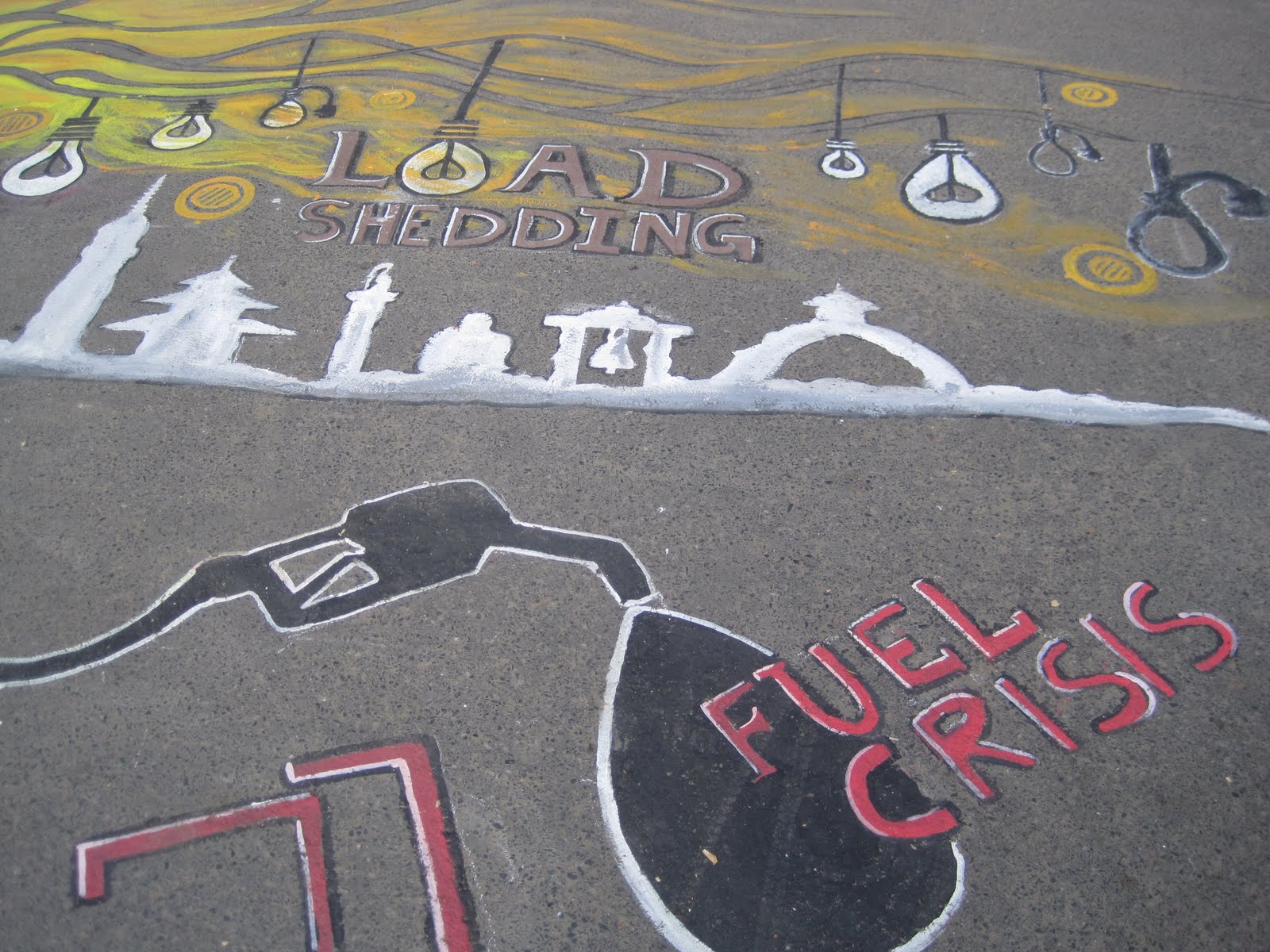
After spending the night at the border town of Kakarbhitta, the plan for the next day was to be driven in a jeep to Kathmandu. Frustratingly, that 600 kilometre trip ended up taking twenty hours because we were stuck from 9am until 4:30pm at a roadblock that was set up in what seemed like the middle of nowhere by locals angry at a recent government decision. This sort of thing is common in Nepal, so the locals just relaxed, waited and asked "What to do?" in a rhetorical rather than a solution-searching way.There was another strike during one of our days in Kathmandu, meaning all businesses stayed closed until the evening. This was organised by students in protest against high gas prices and "load shedding" (the policy where the electricity supply is turned off for up to 18 hours a day for different areas at different times).The Thamel area of Kathmandu reminded me of other tourist hotspots on the world's backpacker circuit. Like Cusco in Peru and Siem Reap in Cambodia, it is filled with Western bars and restaurants, souvenir sellers, internet cafes, travel agents and trekking shops. While obviously this is not the "real" Nepal, we enjoyed treating ourselves to things unavailable in Darjeeling, like falafel wraps and decent pizza. Spending a week with Denna and Helly in Kathmandu, which was a fun and easy reintroduction to backpacking, highlighted how different it is to travel in a group compared to going alone. Because we did not need to, we didn't interact with any other travellers. But when the girls left to return to Darjeeling, I quickly reverted to being the sociable solo traveller - I chatted with three Irish sisters on the six hour bus journey to Chitwan National Park, and once there I teamed up with a Polish girl for an elephant ride and a one and a half day jungle walk.

We set off on that walk after a three minute briefing from our guide: "If a sloth bear attacks, make yourself big and be loud; if a rhino charges, run in zigzags and hide behind a big tree; if you see tiger, keep eye contact and back away slowly". While we saw lots of animals, including rhinos, wild pigs, and several types of deer and birds, as far as we know the closest we came to a tiger was seeing a footprint in the mud.

But the main reason why I had wanted to come to Nepal was to trek. So after an enjoyable day cycling around the villages near Chitwan, I hit for Pokhara - the lakeside town overlooked by the Annapurna range.

Sunday, January 22, 2012

My Winter in Darjeeling

Darjeeling, INDIA: 5 - 17 Jan. 2012
At just over ten weeks, my time in Darjeeling was relatively short. But it was long enough for me to enjoy being settled in one place, to get to know some very nice people, and to grow fond of lots of the little things that make Darjeeling special.

Such things include: the rows of potted plants decorating the front of most homes; groups squatting around small fires on the streets in the evenings; people wearing fake North Face jackets; the smiling legless beggar who appears to rise directly out of the ground; the horse stables just off the main square; the rows of tiny raised stalls where sellers sit cross-legged all day among their wares of gloves, woolly hats and pashminas; children of all ages playing badminton on the streets; enjoying a hair cut, shave and head massage all for less than one euro; the monkeys at the temple atop the central Observatory Hill who groom each other in much the same way as the women pick at each other's hair; cashiers giving sweets to customers instead of small change; the way people talk with their love of emphasis ("these momos are SOOOO tasty") and the common refrain "la, la, la"; and the mountain views which I never tired of appreciating.

Of course, a major reason why I'm happy with my winter in Darjeeling is that my volunteering position at the Edith Wilkins Street Children Foundation worked out well. I was impressed with the life-changing help that EWSCF gives to a large number of children and I'm grateful that I had the opportunity to play a small part. My role involved spending more time helping in the office than I had thought that I wanted to do. Although at times that meant doing things like photocopying and data entry, I felt that the office was the place where I could be of most benefit. I was therefore happy to help out there.

I didn't feel ready to leave Darjeeling, but my soon-to-expire visa meant it was time to go. I guess its not a bad thing to leave a place while the going is still good. And thankfully I wasn't leaving alone as two friends who live in Darjeeling (Denna from the US and Helly from New Zealand) were also going to Kathmandu, so we hit for Nepal together.

By the way, for those of you who associate being in India with suffering "Delhi belly", I'm pleased to report that, apart from a cold, I was happily healthy during my three months there. (What happened after having a cheese-burger in Kathmandu is another story - be glad that not everything is included in my blog!)

Friday, January 6, 2012

Rhinos & Elephants, Bagpipes & Bodybuilders

Siliguri, Jaldapara Wildlife Sanctuary, Darjeeling, INDIA: 26 Dec. 2011 - 4 Jan. 2012

Just like when I spent Christmas in Bolivia two years ago, the biggest difference that I found between Christmas in Darjeeling and in Ireland is that here it is just a one-day event. Unlike Ireland, my life here immediately returned to normal after the 25th. This meant going back to work, and back to playing cricket with the boys.And as in Bolivia where I spent New Years in the obscure city of Oruro, I counted down to 2012 in the equally unattractive city of Siliguri (by the way, the New Years in between was spent in Ballincollig). A big group of us had a fun night of watching our friends' band, dancing in a rocking bar, and singing at a house party - sometimes life in India isn't too different from Ireland.

Siliguri, which is the commercial and transport hub for this region, is a three-hour jeep ride but a world away from Darjeeling. It is warmer (as it is down in the plains) and a lot more hectic, with rickshaws zooming around the busy streets. In other words, it is like all the other places that I've been to in India, apart from Darjeeling. Going to Siliguri showed me how used to life in Darjeeling I have become.

I spent the first night of 2012 in Jaldapara Wildlife Sanctuary, where I went on an elephant ride and saw a few wild one-horned Indian rhinoceros.A train and a jeep ride brought me back up to Darjeeling, where the "Tea and Tourism Festival" was still in full swing. That meant that in one afternoon I was at a dog show, I watched a tartan-wearing, bagpipe-playing Gurkha band,and, most bizarrely, I went to the "Himalayan Classic Bodybuilding Competition".It was a hectic but fun start to 2012 - the final year of my career break!